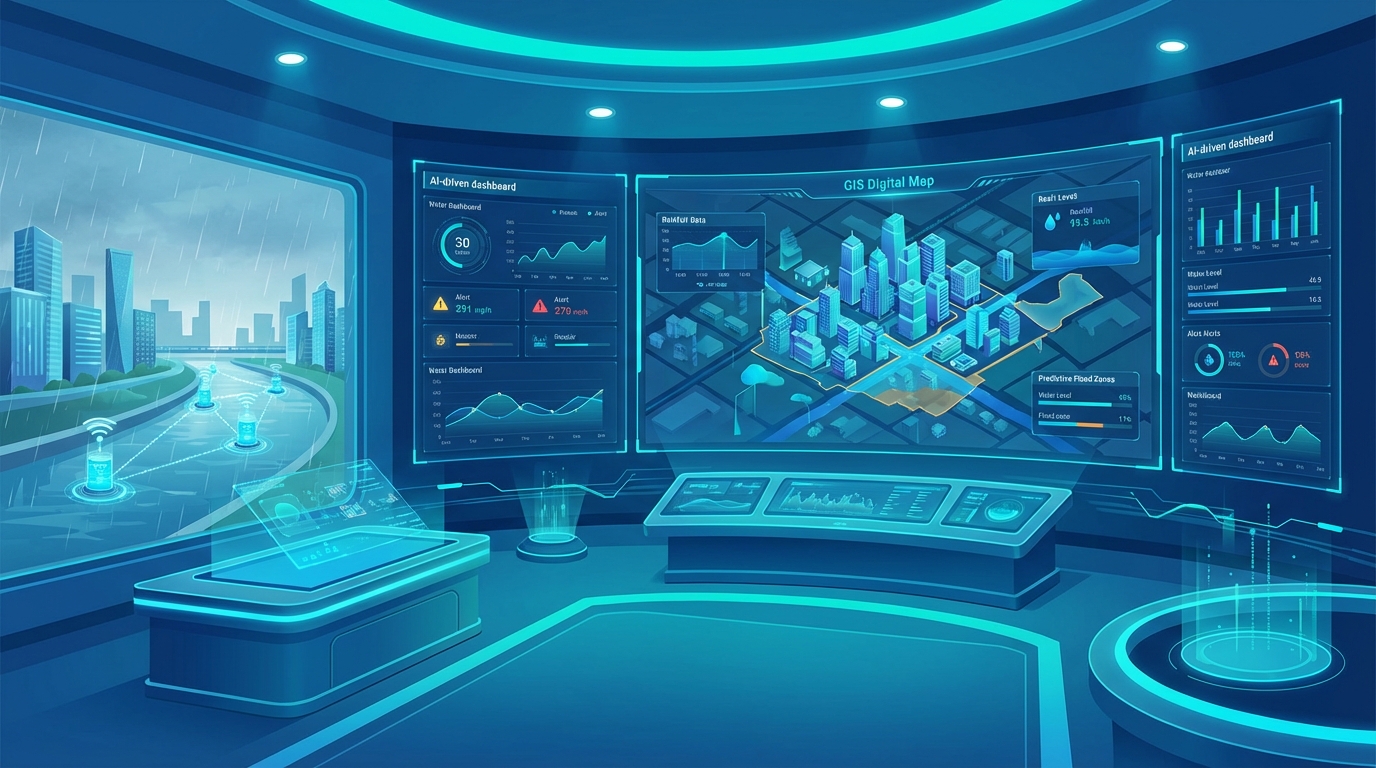
Global Cities Accelerate Deployment of Next-Generation Flood Warning Systems
Recently, multiple cities worldwide have launched new-generation flood monitoring and warning systems based on GIS platforms. Lagos State, Nigeria, took the lead in Africa by deploying an AI-driven flood detection system, significantly improving urban flood control capabilities through intelligent analysis of hydrological data. In the United States, the San Antonio River Authority (SARA) in Texas launched an interactive flood monitoring map, integrating HALT (High Water Alert Lifesaving Technology) sensor data from multiple counties to provide real-time flood information to residents.
Multi-Source Data Integration Becomes New Trend in Smart Flood Prevention
Global cases show that new-generation flood warning systems commonly adopt multi-source data integration solutions, including X-band radar stations, rainfall monitoring equipment, and water level measuring instruments. These devices achieve data integration through a unified GIS platform, with central control centers conducting unified scheduling and analysis. High-precision water level monitoring equipment is one of the core components of these systems.
AI Empowerment Improves Warning Accuracy
Artificial intelligence technology is becoming increasingly common in flood warning systems. Taking Lagos's system as an example, AI algorithms can analyze hydrological data in real-time, predict potential flood risks, and provide decision support for urban planning and emergency response. In Barcelona's metropolitan area, advanced flood models developed by ICARIA and CLIMEMPOWER projects also extensively use AI technology to improve prediction accuracy.
Implications for China's Water Management Market
The global upgrade trend in smart flood prevention systems brings important implications for China's water management market. With accelerating urbanization and increasing extreme weather events, Chinese cities have an urgent need for precise flood warnings. Against this background, high-precision water level monitoring equipment and smart flow metering devices are seeing rapid market growth.
Domestic brands like Ecolor Technology have made breakthroughs in this field. For example, the 80G visual radar water level meter uses advanced radar ranging technology for precise non-contact water level monitoring; HERO V9 RTU supports multi-source data access to meet smart flood prevention system data collection needs; LGF electromagnetic flowmeters and Doppler flow radars provide reliable flow data support for hydrological monitoring.
Future Development Trends
As IoT and AI technologies continue to develop, smart flood prevention systems will evolve toward more intelligent and precise directions. High-precision sensing equipment, real-time data analysis, and intelligent warning systems will become standard configurations, placing higher demands on equipment manufacturers. To learn more about smart water management solutions, please visit Ecolor Technology's website at www.cssoc.com.
Recommended Products
Ecolor Technology provides professional instruments for smart water, environmental monitoring & industrial automation: