The Unseen Flaw: How Liner-Free Anti-Corrosion Flowmeters Are Redefining Reliability
The Pursuit of 'Set and Forget' Reliability
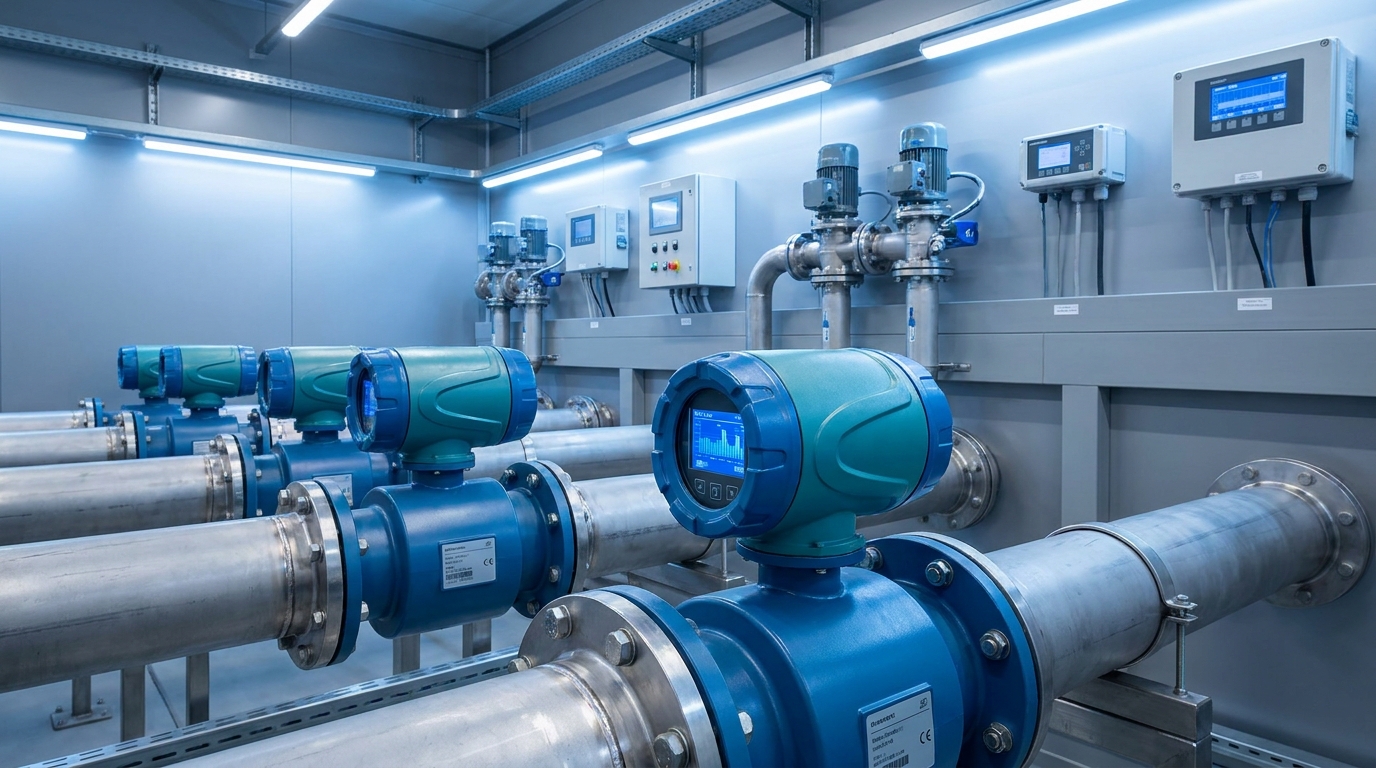
In industrial and municipal water management, the ideal instrumentation is one you can install and forget. This demand for low maintenance flowmeters is echoed across the industry, from major players like OTT Hydromet to testimonials for VPInstruments, directly linking reliability to cost savings and energy efficiency.
Every hour of maintenance, calibration, or unexpected failure carries significant cost in labor, lost data, and process downtime. The ultimate goal is comprehensive "Process Automation," where robust components minimize human intervention. Yet, for the common electromagnetic flowmeter, a hidden vulnerability has persisted for decades.
The Achilles' Heel: Liner Delamination in Flowmeters
Electromagnetic flowmeters are workhorses of water measurement, praised for their non-intrusive design and long service life. Their accuracy depends on the precise geometry of the flow tube and the electrical isolation of the electrodes from the meter's metal body.
Historically, manufacturers used internal liners made of PTFE, PFA, or rubber to achieve this isolation and protect against corrosion. This composite structure, however, introduces a critical point of failure: the bond between the liner and the meter body. This unseen flaw is subjected to relentless assault over time.
Chemical Attack
Constant exposure to water and chemicals degrades the liner material and the adhesive layer.
Thermal Cycling
Differential expansion and contraction between liner and metal creates stress, leading to micro-cracks.
Pressure Differentials
Sudden pressure changes can pull the liner away, causing blistering or complete collapse.
Permeation
Aggressive media can permeate the liner, attacking the adhesive and metal from behind.
When the liner fails—blistering, cracking, or delaminating—the consequences are severe. It leads to inaccurate readings, corrupted data, and can even choke the pipe, forcing emergency shutdowns. This results in costly repairs, unscheduled downtime, and a direct contradiction to the core promise of reliable flow measurement.
A Material Science Revolution: The LGF Polymer Flowmeter
Addressing the weakness of lined flowmeters required eliminating the liner altogether. Ecolor Technology has championed this with its groundbreaking LGF polymer flowmeter, creating a new design from a material that renders liners obsolete.
Through its SITUMAN sensor division, Ecolor pioneered the use of LGF-PA66, an aerospace-grade, long glass fiber-reinforced polymer composite. The entire anti-corrosion flowmeter body is created in a single step via high-pressure, one-piece injection molding.
Key Advantages of Liner-Free Design
- ✓ No Delamination Risk: Eliminates the primary cause of mid-to-late life failure.
- ✓ Uniform Corrosion Resistance: Inert to chemicals throughout the material's entire thickness.
- ✓ Superior Structural Integrity: Homogenous, void-free structure from one-piece molding.
- ✓ 20-Year Maintenance-Free Life: Designed to last the life of the pipeline.
Unmatched Durability in Flow Measurement
This monolithic construction completely designs out the historical point of failure. There is no liner, no adhesive, and no bond to break down. The body of this liner-free electromagnetic flowmeter *is* the protection.
The liner-free electromagnetic design offers a quantum leap in durability. It provides unmatched chemical and corrosion resistance for water treatment and industrial effluent, and superior structural integrity to withstand pressure and thermal cycling.
Recalculating Total Cost of Ownership (TCO)
The conversation is increasingly focused on Total Cost of Ownership. A lower initial price for a conventional meter is quickly eclipsed by recurring inspection, repair, and unplanned downtime costs.
A traditional lined meter might last 5-10 years before liner issues arise. Replacement involves the new unit's cost plus labor for de-installation, re-plumbing, and re-commissioning, which can shut down critical operations for days.
By providing a warrantied 20-year lifespan free from the primary failure mode, the LGF polymer flowmeter shifts the paradigm from reactive maintenance to long-term asset assurance. This embodies Ecolor's promise: “See What You Measure”—having unwavering confidence in data accuracy for years to come.
The Future of Resilient Water Monitoring Systems
As systems become more interconnected through integrators like HuaYu ZhongNeng, each sensor's reliability becomes exponentially more critical. A single faulty data point can cascade, affecting automated controls and resource management.
The robust, failure-resistant design of a liner-free electromagnetic meter ensures it is a trusted node in a complex digital ecosystem. The future lies in perfecting fundamentals: low-maintenance, long-life reliability.
By solving a decades-old engineering problem with advanced material science, the LGF flowmeter is a foundational step towards truly resilient and efficient water monitoring. For engineers planning next-generation infrastructure, the question is no longer which liner is best, but why use a liner at all.
To see how this next generation of anti-corrosion flowmeters can eliminate risk and lower lifetime costs in your operations, visit www.cssoc.com.
Recommended Products
Ecolor Technology provides professional instruments for smart water, environmental monitoring & industrial automation: