The Unseen Threat: Why Urban Flooding Demands a New Defense Strategy
As concrete and asphalt replace permeable green spaces, modern metropolises are becoming increasingly vulnerable to a swift and devastating threat: urban waterlogging. Unlike slow-rising riverine floods, urban flash floods can overwhelm drainage systems in minutes, turning streets into canals, underpasses into deadly traps, and subway systems into subterranean lakes. The Missouri Department of Natural Resources highlights a critical need for systems that provide 'vital flooding information' to help citizens avoid dangerous routes. This challenge is no longer a distant concern but a pressing reality for city planners and emergency managers worldwide. Traditional flood defense, reliant on regional weather forecasts and historical data, is proving inadequate against these localized, high-intensity rainfall events. The fight for urban resilience demands a paradigm shift—from reactive response to proactive, hyper-local, and intelligent monitoring.
From Macro Forecasts to Micro-Level Intelligence
For decades, flood warnings have been built on a foundation of large-scale meteorological data. As noted in analyses of flood warning advancements, technologies like Doppler radar have been instrumental in tracking storm systems, giving communities hours or days to prepare. This macro-level view is essential for regional mobilization. However, it lacks the granularity to predict which specific underpass or low-lying intersection will flood first. To bridge this gap, authorities began deploying networks of automated river gauges, providing real-time data on water levels in key waterways. These systems represent a significant step forward, moving from broad prediction to direct measurement. Yet, even these have limitations in the complex urban environment. Traditional contact-based sensors can be affected by debris and sediment, while stilling wells in storm drains can clog, leading to inaccurate readings or complete failure at the most critical moment. The core issue remains: cities need reliable, low-maintenance sensors that can operate flawlessly in the chaotic conditions of a flash flood.
The Radar Revolution: Precision Data for Waterlogging Warning Systems
The solution to this challenge has emerged from advancements in non-contact sensing technology. The radar water level sensor has become a cornerstone of modern hydrology, offering unparalleled accuracy and reliability. Unlike older ultrasonic sensors susceptible to wind and temperature fluctuations, or pressure sensors that can drift, radar provides a robust measurement immune to most environmental factors. Specifically, 80GHz Frequency-Modulated Continuous-Wave (FMCW) radar, a technology at the heart of Ecolor Technology's SITUMAN sensor line, represents the apex of this evolution. Its high frequency allows for a much narrower beam angle, which is crucial for urban applications. This precision targeting enables the sensor to measure the water level in a narrow storm drain, a culvert, or between the pillars of a bridge without picking up false echoes from surrounding structures. This capability ensures that the data fed into a waterlogging warning system is not just timely, but impeccably accurate. This is the foundation of a reliable automated system that can trigger alarms, close floodgates, or reroute traffic based on trusted, real-time measurements.
'See What You Measure': The Critical Role of Visual Verification
While precise numerical data from a radar sensor is powerful, it doesn't tell the whole story. Is a high-water alert triggered by a genuine flood, or by a temporary blockage from a plastic bag? Are vehicles trapped in the rising water? Is debris obstructing a critical drainage inlet? Answering these questions requires more than just a number; it requires sight. This is the principle behind Ecolor Technology's slogan, "See What You Measure."
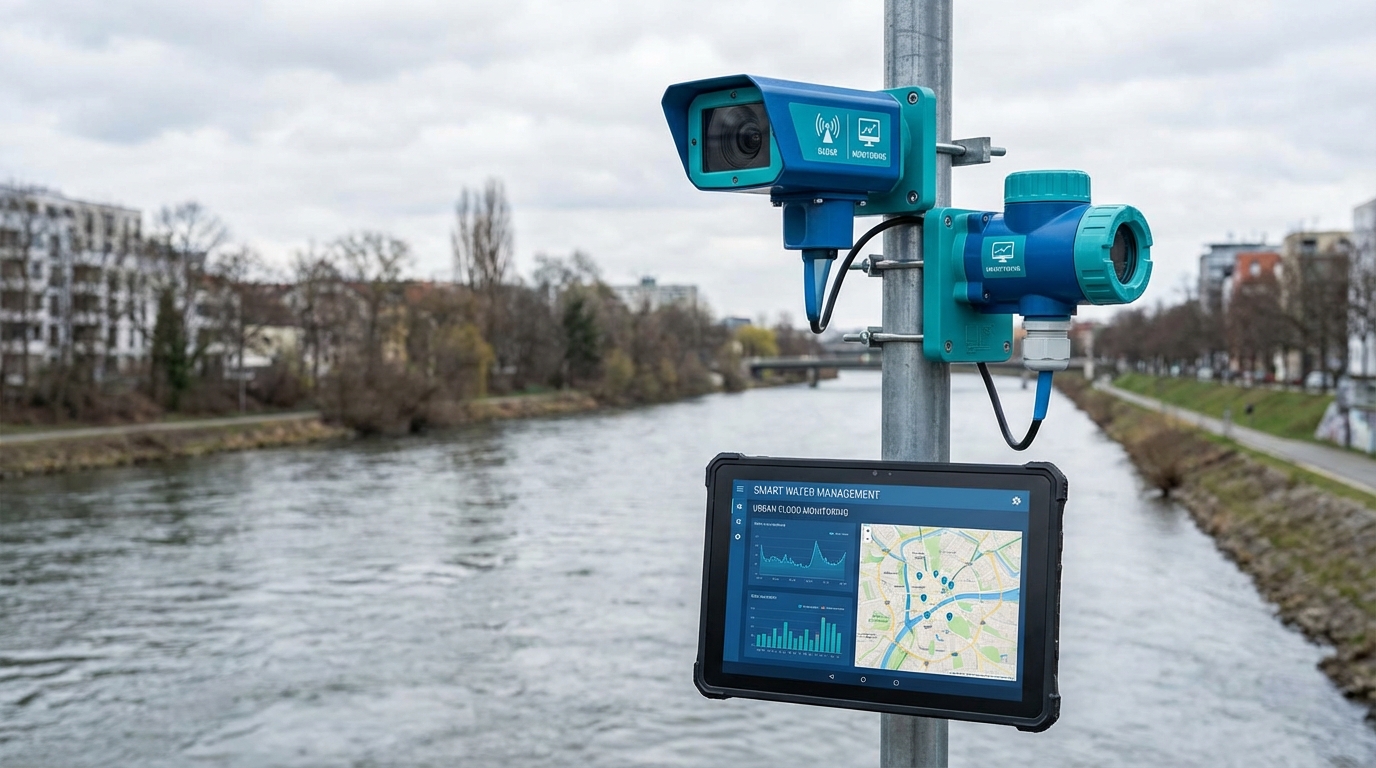
As reporting on environmental monitoring in New South Wales points out, the ability to capture high-resolution images allows authorities to 'see the exact footprint of a flood... in real-time.' By integrating a high-definition camera with an 80GHz radar sensor, a single, solar-powered station can provide a complete intelligence picture. This fusion of technologies transforms a simple monitoring point into a comprehensive situational awareness tool.
- Data Verification: The live video feed allows control room operators to instantly verify a radar-triggered alarm. This eliminates false positives, ensuring that emergency resources are dispatched only when necessary and that public warnings are credible.
- Enhanced Situational Awareness: During an event, emergency responders can access the live feed to assess the situation before arriving on scene. They can identify trapped vehicles, gauge the speed of the rising water, and spot hazards like floating debris or downed power lines, enabling a safer and more effective response.
- Public Safety and Communication: Live or time-lapsed images can be pushed to public-facing websites or mobile apps, like the one implemented by Missouri's DNR. Showing the public a flooded underpass is far more impactful than simply reporting a water level of '2.5 meters,' compelling drivers to heed warnings and avoid the area.
- Post-Event Forensics: The recorded video and data are invaluable for post-flood analysis. Engineers and planners can study how the event unfolded, identify infrastructure bottlenecks, and validate hydraulic models, leading to better-designed, more resilient urban spaces.
Application Spotlight: Defending Critical Urban Infrastructure
The true value of this integrated visual radar technology is most evident in its application at urban chokepoints, the very locations most vulnerable to flash flooding.
Low-Lying Roads and Underpasses
These areas are notorious for rapidly accumulating water. An integrated radar-camera station, often solar-powered for autonomous operation, can serve as a vigilant guardian. When the radar water level sensor detects a critical threshold, the system can automatically trigger flashing warning signs, lower barrier arms to block access, and send an alert to the city's traffic management center. The camera feed provides the traffic operators with immediate eyes on the ground to confirm the hazard and manage detours.
Subway and Metro Entrances
For a major city, the flooding of its subway system is a catastrophic event, causing billions in damages and paralyzing transportation for weeks or months. Placing visual radar stations at flood-prone entrances provides the earliest possible warning. The moment water begins to pool, an alert is sent to the transit authority. Operators can use the live video to assess the threat's severity and make the critical decision to activate floodgates and halt train service in the affected area, protecting lives and preserving a vital piece of public infrastructure.
Building the Smart Urban Flood Defense Network
The ultimate goal is not to deploy isolated sensors but to build a comprehensive, city-wide urban flood monitoring network. Each solar-powered visual radar station acts as a smart node, feeding a constant stream of numerical and visual data into a central command platform, often managed by system integration experts like HuaYu ZhongNeng. This unified system aggregates data from hundreds of points, creating a real-time, high-resolution map of the city's hydrological status. This empowers city managers to move beyond the simple 'flood sensor' concept used in homes, as described by outlets like Alarm Grid, and implement a true, industrial-grade public safety infrastructure. This network enables a coordinated response, orchestrating everything from traffic signal adjustments and public alert dissemination to the strategic deployment of emergency services. It transforms flood management from a series of disjointed actions into a synchronized, intelligent defense. As cities continue to grow and climate patterns become more volatile, investing in this level of granular, verifiable, and actionable intelligence is no longer a luxury—it is essential for safeguarding lives and securing our urban future. To discover how integrated visual radar solutions can form the backbone of your city's resilience strategy, explore the innovative instrumentation available from Ecolor Technology at www.cssoc.com.
Sources
Recommended Products
Ecolor Technology provides professional instruments for smart water, environmental monitoring & industrial automation: